Why Smartest browser tests
Smartest is invented to make Ruby browser testing smarter, not just slightly nicer.
The direct inspiration is Playwright Test: its authors built a dedicated test runner instead of writing yet another Jest plugin, because browser testing is a different domain from unit testing — not just unit testing with a browser bolted on top. Smartest brings that same move to Ruby. Rather than plug Playwright into RSpec or Minitest, it rebuilds the runner around pytest-style fixtures so that the Playwright runtime, browser, and page lifecycles are expressed directly in each test's signature. See Introducing pytest-style fixtures into Ruby for smarter browser testing for the longer story.
In practice this means you stay in Ruby: each browser test receives a page:
fixture and drives it with the full Playwright API. Smartest scaffolds the
setup for you, and the four steps below take you from zero to a passing
browser test.
Quick Start
1. Initialize the scaffold
bundle exec smartest --init-browser
This sets up everything needed to run Playwright browser tests. If your
Gemfile was created with bundle init, Smartest keeps or adds gem "smartest",
adds the playwright-ruby-client gem, installs the Playwright Node.js package
and browsers, and creates example fixture / matcher / test files under
smartest/.
websocket-driver is REQUIRED only when connecting to a remote Playwright
server with PLAYWRIGHT_WS_ENDPOINT or
Playwright.connect_to_browser_server. The local scaffold path uses
Playwright.create and does not need it.
2. Run the generated example test
bundle exec smartest smartest/example_browser_test.rb
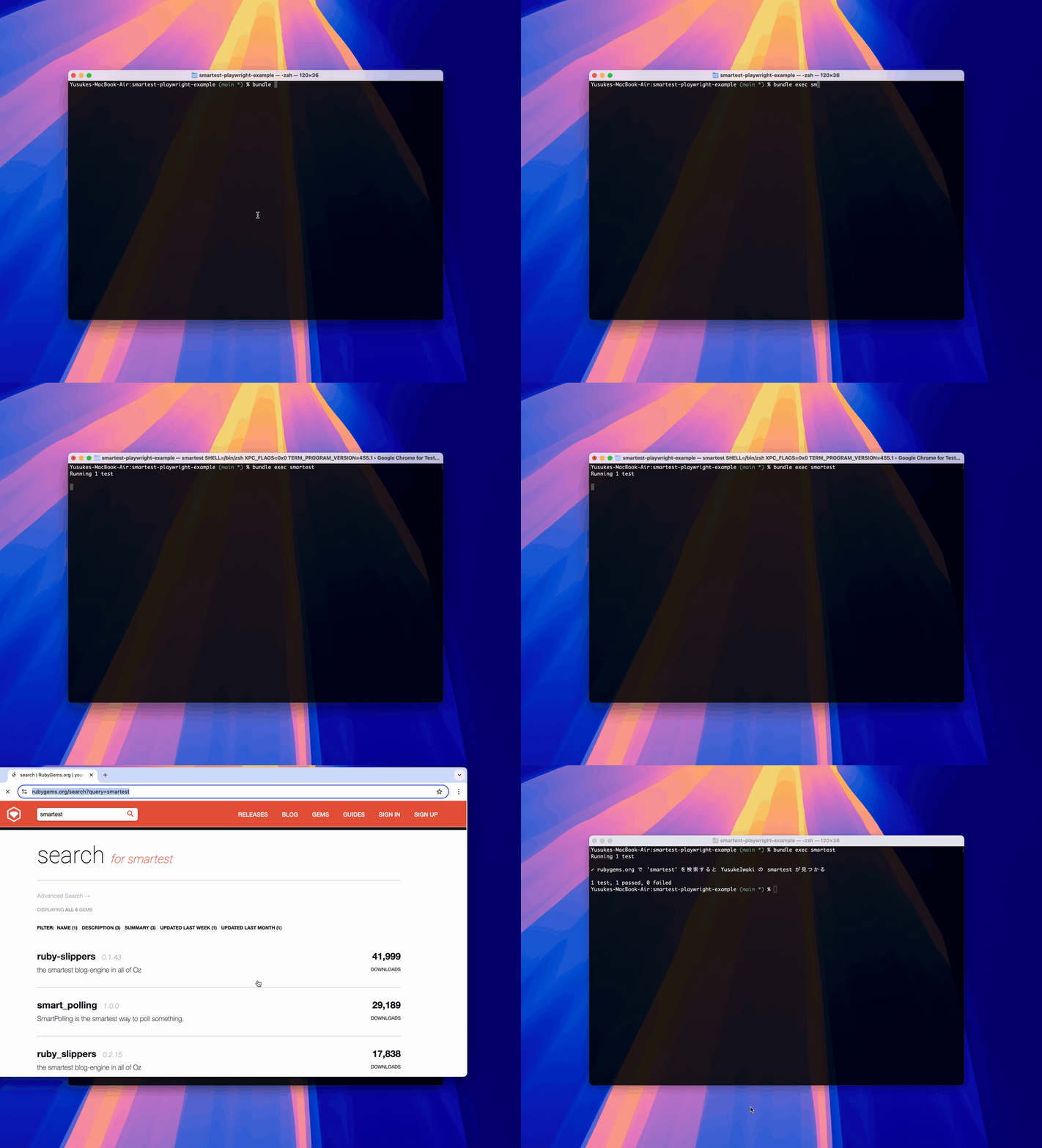
3. Write your own browser test
Inside any test file under smartest/, declare a test that takes the page:
fixture. page is a Playwright Page, so the full Playwright Ruby API is
available. Smartest expectations support Playwright matchers like have_url
and have_text. The generated example includes a RubyMine type comment so
completion works for the Playwright page fixture.
require "test_helper"

# @type [Playwright::Page] page
test("finds the smartest gem on RubyGems") do |page:|
  page.goto("https://rubygems.org/")
  page.locator("input[name='query']").fill("smartest")
  page.keyboard.press("Enter")

  page.locator("a[href='/gems/smartest']").click
  expect(page).to have_url("https://rubygems.org/gems/smartest")
  expect(page.locator("h1")).to have_text("smartest")
end
Each test gets a fresh browser context and page; the Playwright runtime and browser process are shared across the suite.
4. Control the browser via environment variables
The scaffold reads three environment variables at launch time:
| Variable | Values | Effect |
|---|---|---|
BROWSER | chromium (default), firefox, webkit | Which browser type to launch. |
HEADLESS | 1 / true (default), 0 / false | Set to 0 or false to show the browser window. |
SLOW_MO | integer (milliseconds) | Slow each Playwright action by N ms. 0 (default) disables it. |
Examples:
# Run with Firefox
BROWSER=firefox bundle exec smartest smartest/example_browser_test.rb

# Show the browser and slow it down so you can watch the test
HEADLESS=0 SLOW_MO=250 bundle exec smartest smartest/example_browser_test.rb
That's everything you need to start writing browser tests. The rest of this page explains what the scaffold generated and how to tune it.
How it works
smartest --init-browser generates three Ruby files. They are ordinary
Smartest fixtures and matchers — edit them freely to tune behavior.
What --init-browser generates
On top of the normal smartest --init scaffold, the command:
- creates
smartest/fixtures/playwright_fixture.rb - creates
smartest/matchers/playwright_matcher.rb - creates
smartest/example_browser_test.rb - registers
PlaywrightFixtureandPlaywrightMatcherintest_helper.rb - keeps or adds
gem "smartest"in the Gemfile - adds
gem "playwright-ruby-client", group: :testto the Gemfile and runsbundle install - runs
npm init --yeswhen nopackage.jsonexists yet - runs
npm install playwright --save-dev - runs
./node_modules/.bin/playwright install
Test helper
The generated helper loads fixture and matcher files, then registers the Playwright fixture and matcher for the suite:
require "smartest/autorun"

Dir[File.join(__dir__, "fixtures", "**", "*.rb")].sort.each do |fixture_file|
  require fixture_file
end

Dir[File.join(__dir__, "matchers", "**", "*.rb")].sort.each do |matcher_file|
  require matcher_file
end

around_suite do |suite|
  use_matcher PredicateMatcher
  use_fixture PlaywrightFixture
  use_matcher PlaywrightMatcher
  suite.run
end
Add your own fixtures or matchers here, or replace PlaywrightFixture /
PlaywrightMatcher with subclasses of your own.
Browser lifecycle fixture
The fixture class owns the Playwright runtime, the browser process, and the
per-test page. This is where the BROWSER / HEADLESS / SLOW_MO
environment variables are read — change this file to add launch options
(viewport size, locale, custom args, …) or to change the per-test context
(authentication state, recorded videos, …).
require "playwright"

class PlaywrightFixture < Smartest::Fixture
  suite_fixture :playwright do
    runtime = Playwright.create(
      playwright_cli_executable_path: "./node_modules/.bin/playwright",
    )
    on_teardown { runtime.stop }
    runtime.playwright
  end

  suite_fixture :browser do |playwright:|
    browser_type = case ENV["BROWSER"]
    when "firefox"
      :firefox
    when "webkit"
      :webkit
    else
      :chromium
    end

    launch_options = {}
    launch_options[:headless] = !%w[0 false].include?(ENV["HEADLESS"])
    if (slow_mo = ENV["SLOW_MO"].to_i) > 0
      launch_options[:slowMo] = slow_mo
    end

    browser = playwright.send(browser_type).launch(**launch_options)
    on_teardown { browser.close }
    browser
  end

  fixture :page do |browser:|
    context = browser.new_context
    on_teardown { context.close }
    context.new_page
  end
end
Lifecycle summary:
:playwrightand:browseraresuite_fixtures — created once and reused.:pageis a regularfixture— created fresh for each test, with its ownBrowserContextso cookies and storage are isolated.
Playwright matcher
The matcher module exposes Playwright's web-first assertions (have_url,
have_text, be_visible, …) to Smartest's expect(...).to ... syntax:
require "playwright"
require "playwright/test"

module PlaywrightMatcher
  include Playwright::Test::Matchers
end
Add your own matcher methods to this module if you want project-specific assertions on Playwright objects.